

Skip links

Student FAQ's

Student Information

Who can learn to Fly?

Anyone of any age can learn to fly. There are no requirements to fly with an instructor in New Zealand. There are specific requirements for going solo or holding a licence. Please see the Flight Training section for more information.

Christchurch is a welcoming city with wide open, clean green spaces, and a safe and caring community.

Are there any pre‐requisites for course entry?

Civil Aviation Authority of New Zealand (CAANZ) requires that you must be 16 years old to fly solo and 17 years old to hold a Private Pilot Licence. CAANZ also requires that a person must be 18 years old to hold a Commercial Pilot Licence. The CAANZ has no minimum educational requirements for a CPL, but high school Maths and Physics are useful.

For our Diploma course the Academy does not accept any students (domestic or international) less than 18 years of age. Students wishing to access student loan funding will required to hold NCEA Level 3 with at least 14 L3 credits in English rich subjects (English, History, Geography, Biology, Classical Studies, Art History, Journalism, Media Studies, Religious Studies, PE) and 14 L3 credits in Maths orientated subjects (Physics, Chemistry, Calculus, Accounting, Economics) – or equivalent.
OR
Apply for special admission as an adult learner (over 20 years of age) with relevant work experience, prior flight experience at an aero club, or experience working with heavy machinery.
OR
If accepted you must pass all your Private Pilot License theory exams or equivalent.
 
All students are subject to interviews and assessments prior to assessment. 

I wear glasses, will this be a problem?

You will have to meet minimum medical standards, but in most cases this will not be a problem. Many airline pilots wear glasses. We recommend you consult an Aviation Medical Examiner.

I have already flown for some hours. Will this affect my training?

Any previous training will be assessed and recognised as prior learning given on production of evidence. Students will fill out an RPL form and be required to show their logbook/any Aspeq exam slips relevant to their situation. Once your prior learning has been recognised, your course fees will be reduced accordingly.
 
For guidance on the amount of prior training recommended, please refer to ‘Should I complete my PPL before applying for the Diploma?’

Can I work while I am at the Academy?

Students are able to work part time however, it is most important that a job should not be allowed to interfere with the prime objective of training. Students should not expect part‐time work to pay for their course, but wages can subsidise living expenses.

Is a job guaranteed?

We will provide you with a high standard of training and the accompanying skills required for you to be employed in your chosen sector of aviation. We cannot guarantee you a job. As with any training, the ability to convert learned skills into employment is up to you, how you seek the opportunities and make the most of those presented to you. The demand for well trained and qualified pilots worldwide remains very high. Our graduates hold flying positions in many parts of the world and throughout New Zealand.

What can I do with a PPL?

A PPL allows the holder to operate as pilot in command of an aircraft as long as it is not for hire or reward. This means that you can fly for fun by yourself or with passengers as long as you are appropriately current and rated for that flight. Once you gain your PPL you can then move on to a night rating, fly different types of aircraft or even try your hand at flying twin engine aircraft.

Does my licence expire?

Your licence is valid for the lifetime of the holder. It should be noted though that there are currency requirements and a biennial flight review to ensure that you are operating the aircraft safely

English is not my first language, can I still learn to fly?

To hold a licence in New Zealand you must be assessed to be proficient in speaking, reading and understanding English. Your instructor will assess your English as you learn to fly and all pilots must pass a formal test before applying for their licence.

Which course is suitable for me?

This depends on your final goal. If your goal is to fly for an airline, you will require a Commercial Pilot Licence (CPL) and potentially a Multi Engine Instrument Rating too. The NZ Diploma in Aviation will provide you with these qualifications. If your goal is to work as or for a scenic flying operator, or as an agricultural pilot you will probably only require a CPL. If your goal is to work as a Flight Instructor, you will require a CPL and a Flight Instructor Rating. If your final goal is one of the above, but for reasons of finance or available time you are unable to undertake the complete course, we can offer our PPL/CPL Theory Course. This will give you a full Private Pilot Licence with the theory component of the CPL. This provides an ideal starting platform from which to complete your CPL at a later date. If you already have a licence or rating we can provide additional courses or ratings as required. If you cannot train full time with IAANZ we can structure your course on a part‐time basis through the Canterbury Aero Club.

Are any loans or allowances available?

The Academy’s Diploma courses are approved by the New Zealand Qualifications Authority and because of this, student allowances and loans are available for New Zealand Citizens or New Zealand permanent residents who have had residency for a minimum of three years. For further information on loans and allowances go to (www.studylink.govt.nz).

Is the New Zealand Pilot Licence recognised overseas?

The New Zealand CPL is well respected worldwide and “Kiwi” trained pilots are in demand by many airlines. The Licence meets the International Civil Aviation Organisation (ICAO) standards. In many cases a licence conversion will simply require passing the local flight rules examination, completing a flight test and obtaining a local medical for the type of licence you hold.

I'm interested in aviation but I don't know where to start. What do you recommend?

If you’re new to aviation, the volume of information can feel overwhelming. A great first step is to book an introductory flight with the Canterbury Aero Club to see if you enjoy being in the cockpit.
 
From there, speak with instructors and club members to learn more about the training journey. If you’re keen to continue, schedule a Class 1 Medical to confirm you’re medically fit to pursue pilot training. This isn’t technically required until your start date with IAANZ, but we recommend locking this in early so there are no unexpected surprises. 
 
Once you’re ready to take the next step, contact IAANZ on +64 3 358 0477 to arrange a tour of our facilities and discuss your future training options.

Should I complete my PPL before applying for the Diploma?

We strongly recommend that students begin their flight training as part of the Diploma programme, rather than completing a PPL beforehand. 
 
Firstly, students who complete their PPL through a different training provider may not gain experience flying in controlled airspace, which is an essential part of our training at Christchurch International Airport. This can result in additional time and cost later, as further instruction may be required to meet the standard expected at IAANZ.
 
Secondly, completing a PPL prior to enrolling can create funding complications. The first year of the Diploma is structured as a 43-week programme; arriving with a full PPL may lead to an extended gap before students are eligible to access second-year funding, which can disrupt training progression and any allowances the student may receive.
 
Thirdly, starting with the Diploma from the beginning supports better resource planning. Our programme is designed around consistent student progression, and entering partway through can affect aircraft availability, instructor scheduling, and classroom placement.
 
If you are really keen to get started, we recommend a maximum of 1-3 PPL exams and reaching your first solo flight, then pausing your training until you get to IAANZ. Applicants who have progressed significantly beyond this point may find their prior training is not well-aligned with our programme structure, which can affect their overall suitability for selection.

What advantages does the International Aviation Academy have?

You are able to train in the professional environment of an international airport. If you are aiming to become an airline pilot, it makes sense to train in a working airline environment. With our partnership with Air NZ, we are one of their “preferred” flight training organisations, gives you reassurance that we are training you to the standards and requirements of Air New Zealand.

This partnership means that our training is now geared directly at the airlines with two crew, multi crew training being implemented from day one. Using standardised Route Guides and Standard Operating Procedures, all of our students are benefitting greatly from this enhanced training which prepares them much better for a life as an airline pilot.

Flying with us in Christchurch is not only beneficial as CHC has excellent weather with high sunshine hours, but you will have the use of our own satellite airfield at West Melton, six minutes flying time from Christchurch Airport. There will be times, particularly at early stages of training, when the quieter environment of our own airfield at West Melton will be a more suitable training ground. West Melton has six runway vectors and is for the exclusive use of our pilots.

We have three large training areas and three low flying areas in close proximity. You will have the use of our large single and multi engine aircraft fleet. We are the largest operation of our kind in New Zealand.

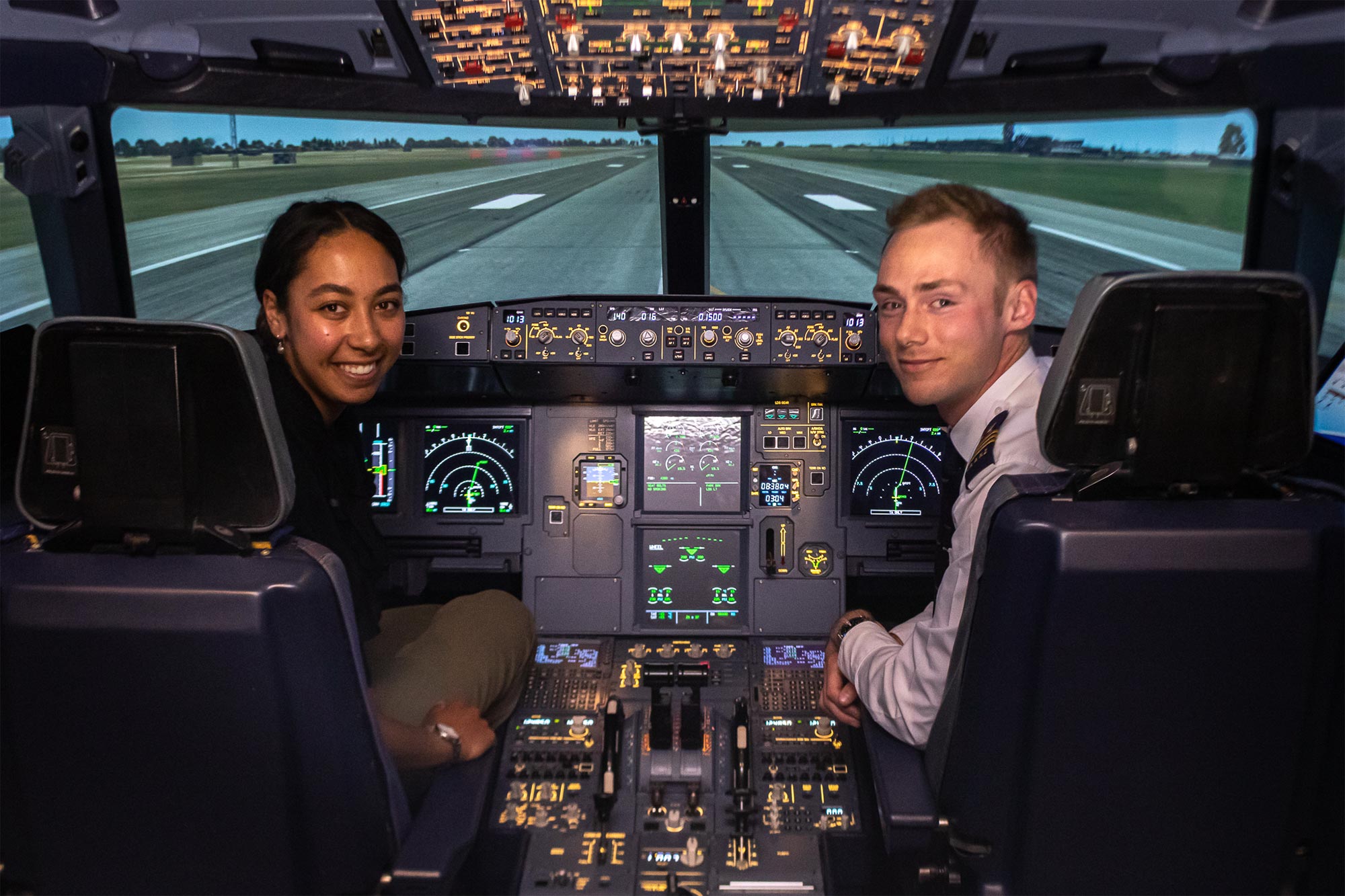
Access to the Simulator centre will allow you to hone your skills or complete an MCC Course or Pilot Interview Preparation course in the PS4.5 Eurojet Simulator based on an A320 to make you work ready.

As a student of the Academy you will receive automatic membership of our parent company, the Canterbury Aero Club. This will give you reciprocal rights to a network of some 50 Aero Clubs in New Zealand ‐ thus giving you the advantage of obtaining briefings and “local knowledge” on cross country flights away from your home base. You will have access to our large engineering facilities which not only provide prompt, safe and efficient “in house” maintenance of our fleet, but allow you a valuable insight into maintenance operations.

In addition to the above, you will have access to IAANZ online training product “e-Aviator” which allows you 24/7 access to interactive course content, practice exam papers and knowledge check quizzes. This product will enhance your face to face learning experience or give you the opportunity to complete your PPL theory subjects before joining the Academy.